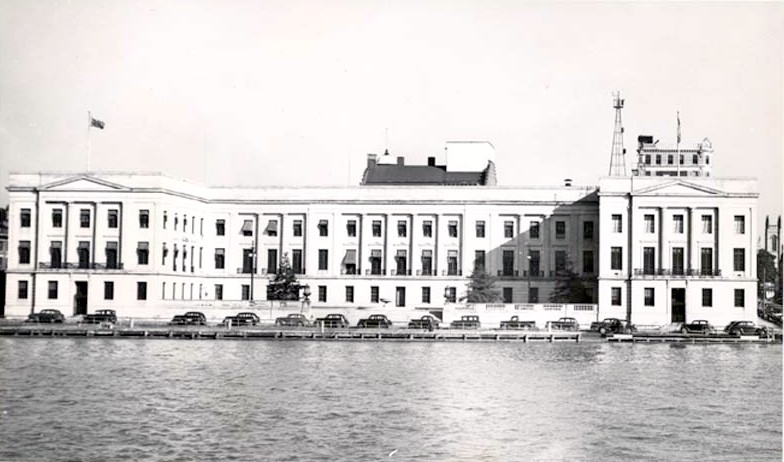
Wilmington in 1918

Philatelic History of     Wilmington, North Carolina

Revised 05/16/2008


Philatelic Item

It is WPS's hope that this web-page will serve to stimulate an interest in the collecting, conservation and documentation of postal history covers of Wilmington.     
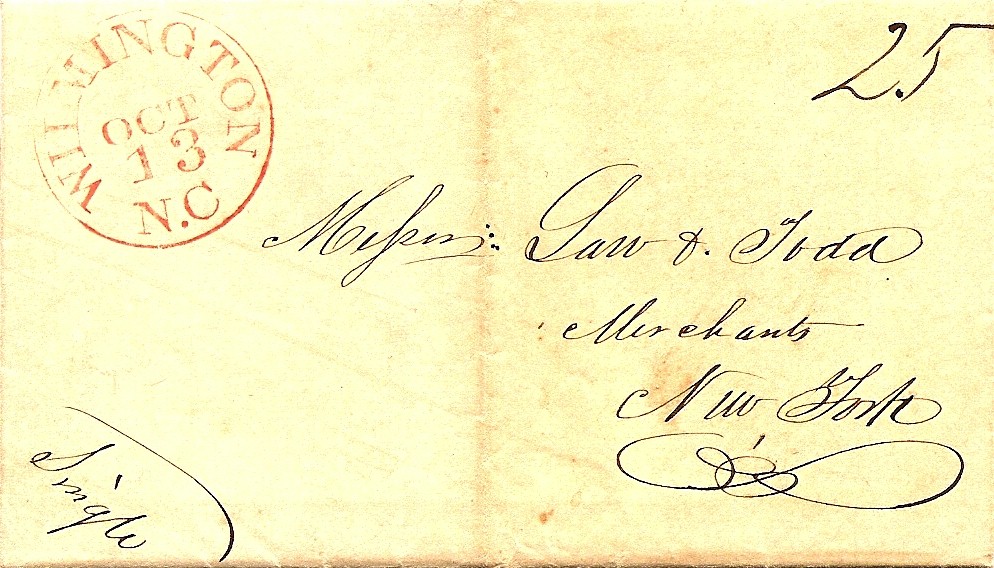
Year Pix Cat # Description By
Wilmington is a city in New Hanover County, North Carolina, United States. Wilmington's population surpassed 100,000 in 2006. Today Wilmington is known as the "Port City" and thrives as a seaport, premier tourist and film-making destination.
        Visit the North Carolina Museum of History located in Raleigh.
        Visit the Cape Fear Museum of History & Science located in Wilmington.
~~~~~~~~~~~~~~~~~~~~~~~~~~~~~~~
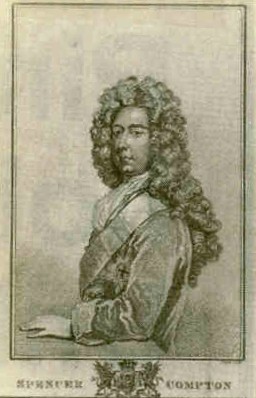
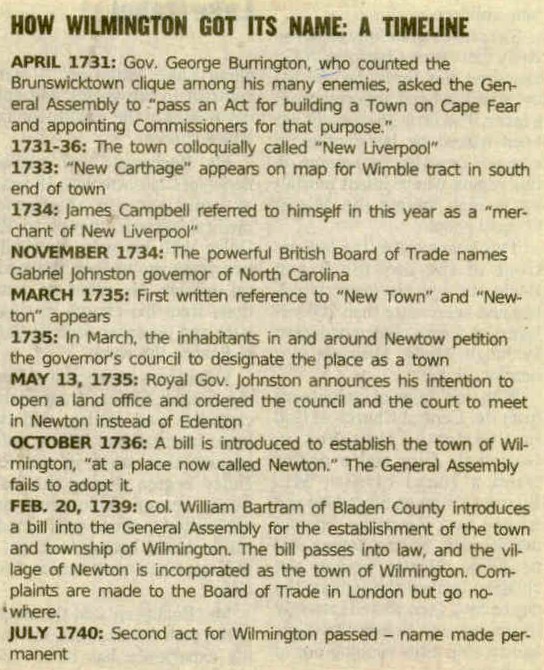
Attempts to settle the Cape Fear region were made in the 1600's. The first permanent English settlers established themselves in the area in the 1720's. The growth of a village on the Cape Fear River went through several names, earlier called New Liverpool, afterwards called Newton and lastly, Wilmington. The colonial township of Wilmington was incorporated in 1739. It was named in honor of Spencer Compton, the Earl of Wilmington, who was Prime Minister under George II. (TimeLine - How Wilmington Got Its Name) Slavery came early to the region as landowners used slave labor to exploit the region's natural resources. The forest provided the region's major industries through the 18th and most of the 19th century.
~~~~~~~~~~~~~~~~~~~~~~~~~~~~~~~
In 1763 Andrew Stewart began printing a newspaper in Wilmington called The Cape Fear Gazette and Wilmington Advisor. It was succeeded in 1767 by the newspaper, Cape Fear Mercury published by Adam Boyd.
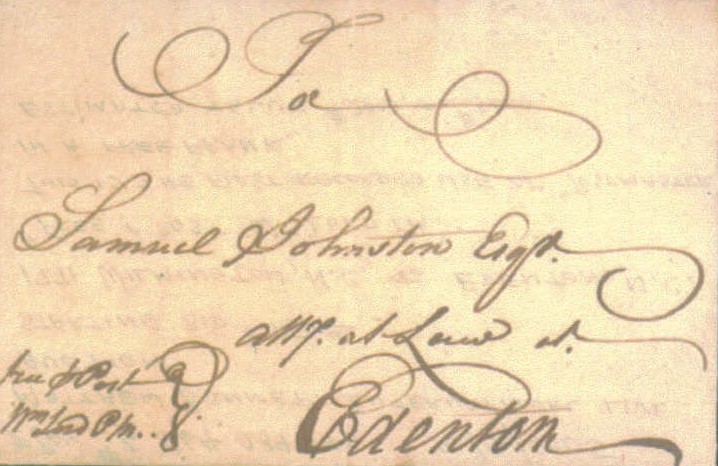
1771 Xoom View ---         A letter sent from Wilmington to Edenton NC (Free P Post - Wm Lord Pm). This is the first recorded use of "Postmaster" as a free frank. WT
Naval stores and lumber fueled the Wilmington economy both before and after the American Revolution (1775-76). The area was home to several notable Revolutionaries including: William Hooper, a signer of the Declaration of Independence and Cornelius Harnett, a member of the Continental Congress.
~~~~~~~~~~~~~~~~~~~~~~~~~~~~~~~
July 26, 1775 - The Second Continental Congress meeting in Philadelphia established an American Post Office with Ben Franklin as Postmaster General. It provided a line of posts from Falmouth in New England to Savannah, Georgia.
~~~~~~~~~~~~~~~~~~~~~~~~~~~~~~~
April 12, 1776 - The North Carolina assembly was the first to empower its delegates in the Continental Congress to vote for independence from Britain.
July 4, 1776 - United States Declaration of Independence was signed.
~~~~~~~~~~~~~~~~~~~~~~~~~~~~~~~
In 1789 North Carolina joined the newly formed United States of America as the 12th of the original 13 colonies.
~~~~~~~~~~~~~~~~~~~~~~~~~~~~~~~
In 1796 North Carolina erected its first permanent lighthouse on Bald Head Island. Early river pilots used Bald Head as their navigational marker to enter the Cape Fear River to get to Wilmington. The island headland was worn bare of vegetation making it stand out in contrast to the forest behind it. This bald headland became a reference point, known as Bald Head Island.
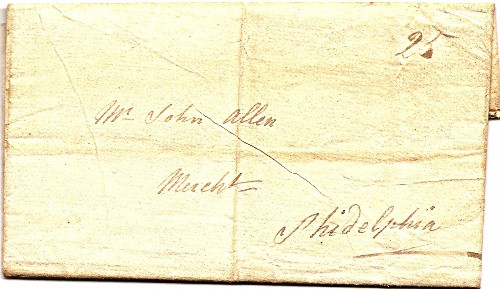
1798 Xoom View ---          A stampless cover sent on July 8, 1798 by Jane Walker from Wilmington NC to John Allen in Philadelphia Pa.
Letter content: Walker explains her reasons for being late in making payment for goods that she received.
GS
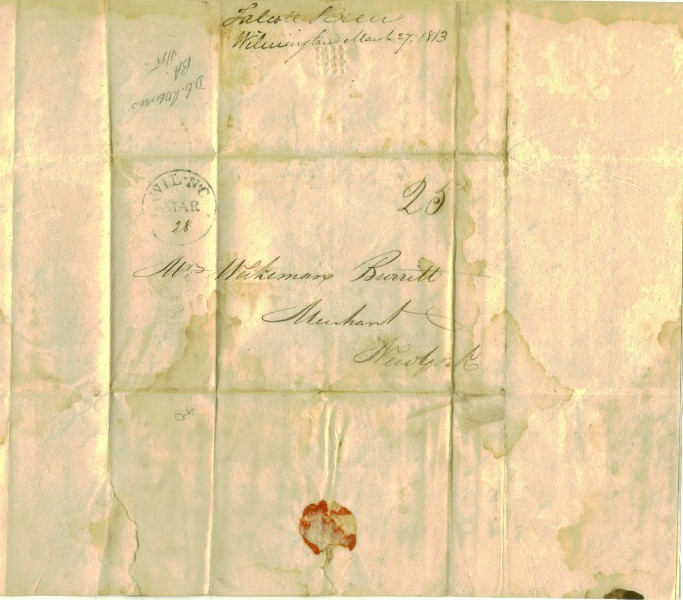
1813 Xoom View ---         A stampless cover sent on March 27, 1813 by Talcott Burry from Wilmington to Whiteman Burritt, merchant in New York.
Letter content:     Enclosed I forward you a bill of exchange on John F Brugwin at sixty days sight for eight hundred dollars. I have to request you - when this bill is paid, to pay Mr Mortimer Bradley, one hundred dollars for my account. Leut Cowan arrived in town last evening and is much pleased with the military goods, have not received pay for them yet, but expect to in a few days - flour firm $13.50 to $14 in Charleston and every bunch that has been brought to this market for sometime has been shipped to that place. Master Arnold and myself has made a shipment of 100 bunches to Charleston which we expect to get from $13 to $14 dollars, per bunch.
RP
In 1818 David Smith commenced publication of a Wilmington newspaper, the Cape Fear Recorder.
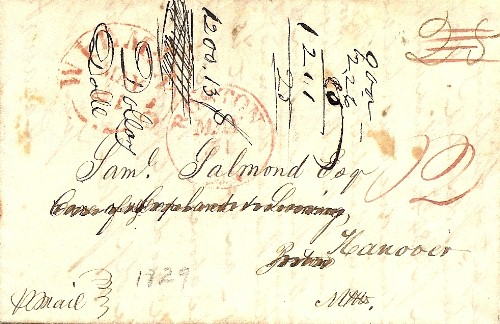
1829 Xoom View ---         A stampless cover sent on May 21, 1829 from Wilmington to Boston MA (25 cents) and then forwarded from Boston to Hanover NH (12 cents). Contents: An Invoive for Cargo being shipped by Lazarus & Whitmarsh on the Brig - Crusader (John Fletcher, the Master). The Invoice total was $1203.97 with the cargo bound for Matanzas (Cuba). GS
In 1832 Henry S Ellenwood established a Wilmington newspaper, the Wilmington Advertiser. Contemporary with this, PW Fanning and Thomas Loring published the People's Press. Later in 1838 Asa A Brown began publishing the Wilmington Chronicle and in 1844 Alfred Price and David Fulton began publishing the Wilmington Journal.
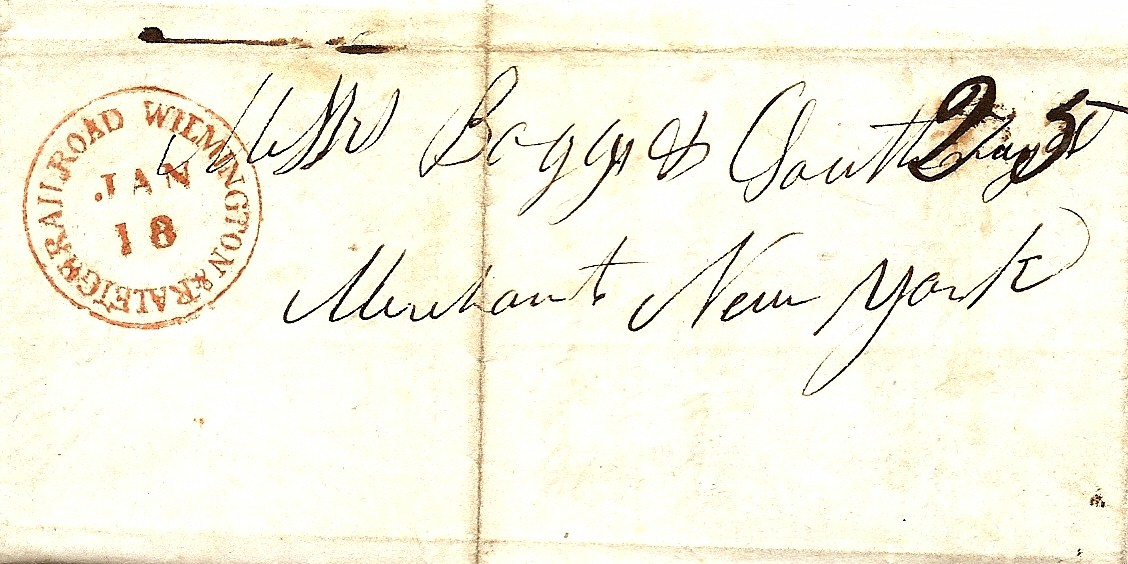
1845 Xoom View ---         A stampless cover cancelled by the Wilmington & Raleigh Railroad on January 18, 1845 and sent to New York (25 cents).
History:    The first railroad company to operate in North Carolina was the Petersburg Railroad. By 1833 track was laid between Petersburg VA (south of Richmond VA) including nine miles of track near Halifax NC. In December 1937 the Petersburg Railroad crossed the Roanoke River by bridge.
        The Wilmington & Raleigh Railroad was chartered in 1834 to build its railroad from Wilmington to Raleigh. While it had financial backing from Wilmington residents it did not have the support from Raleigh so the Wilmington stockholders petitioned the legislature in 1836 to change the route to run from Wilmington to Weldon in Halifax County. When completed on March 9, 1840 the Wilmington & Raleigh Railroad was 161 miles long and earned the title of the world's longest railroad. It would connect the city of Wilmington with the Richmond and Petersburg Railroad and the Raleigh & Gaston Railroad a month later in April 1840.
        North Carolina's state legislature approved the creation of the North Carolina Railroad in 1849. The Wilmington & Raleigh railroad was reorganized in 1851 with state and private ownership and in 1854 was renamed the Wilmington & Weldon Railroad. In January 29, 1856 North Carolina's rail system would become the link between South Carolina's rail system and Virginia railroads over 223 miles of track.
        Visit the Wilmington Railroad Museum.
GS
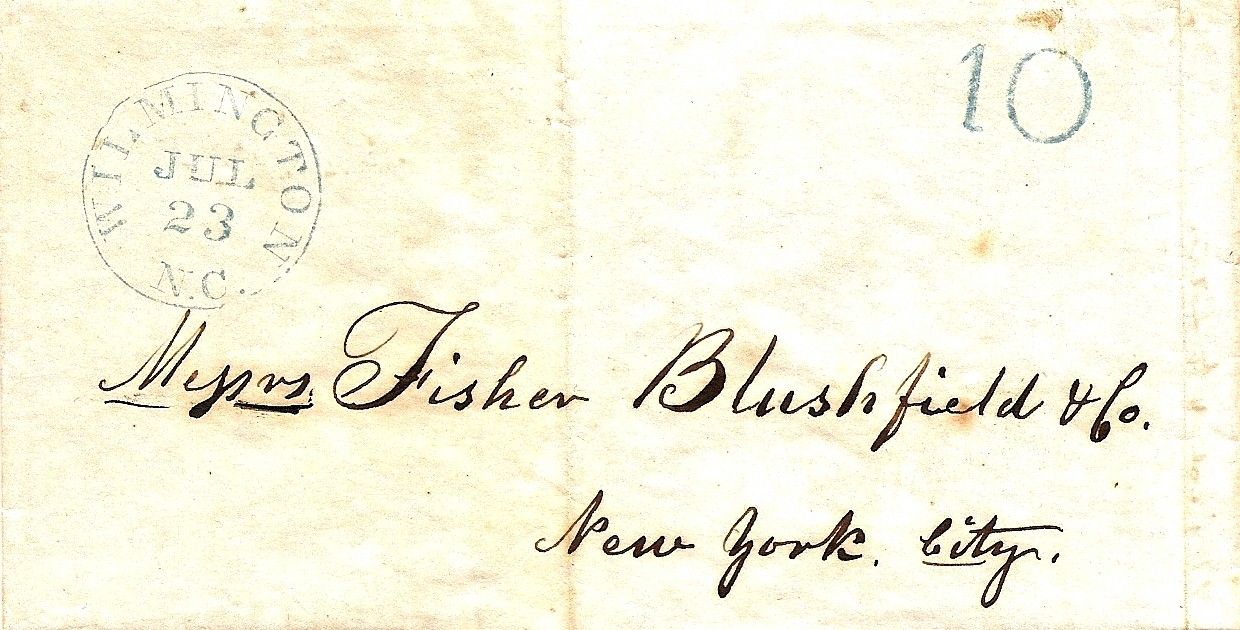
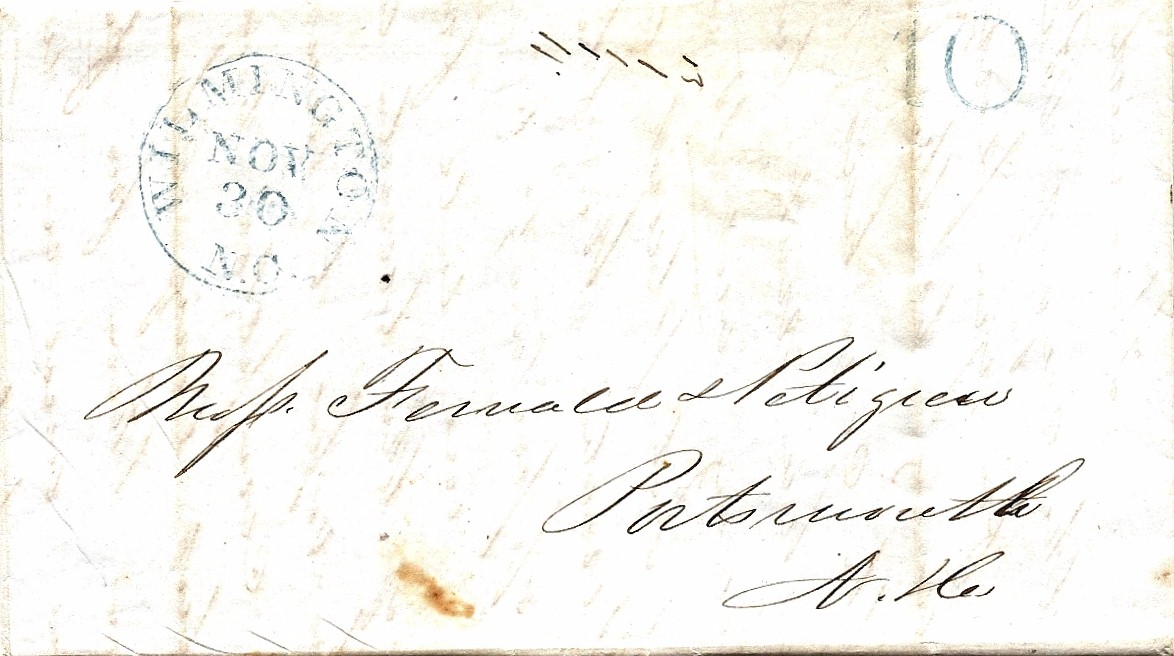
Up to 1845 postal rates for a single sheet of paper was 12 1/2 cents and for a double sheet, 25 cents. The first US postage stamps were issued in 1847 but their use was mainly in large cities. Initially the payment of postage was made by the receiver and not by the sender which resulted in a lot of uncalled-for letters. To encourage the use of the post office, postal rates were reduced to 5 cents for a single sheet and 10 cents for a double sheet and stamps were sold for the pre-payment of postage by the sender. The first post office in Wilmington was located in the old Custom House which was completed in 1846.
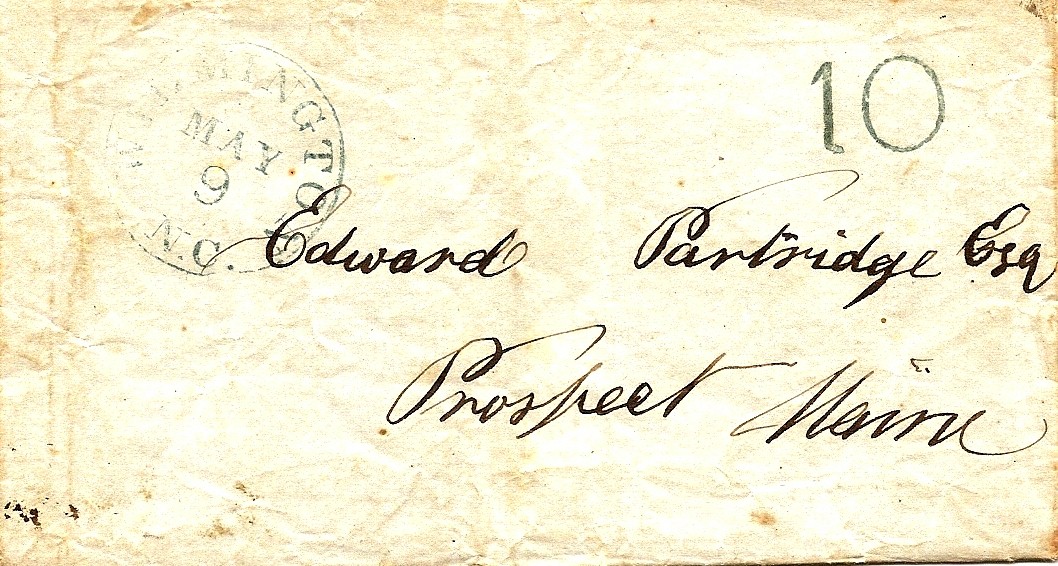
1849 Xoom View ---         A stampless cover cancelled in Wilmington on May 24, 1849 and sent to DA Davis in Salisbury NC (5 cents). It was sent by Henry Russell Savage who was a cashier from 1847 to 1861 in the Wilmington headquarters of the Bank of Cape Fear. During this period Wilmington resident, Thomas Henry Wright was president of this bank.
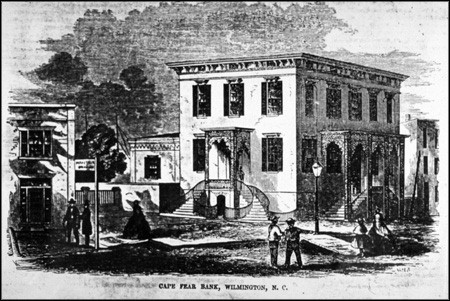
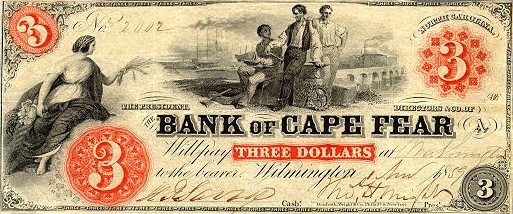
History:    The first banks in North Carolina were chartered in 1804. The Bank of Cape Fear in downtown Wilmington was chartered on December 17, 1804. The Bank of New Bern headquartered in New Bern NC was also chartered in 1804 followed by the State Bank of North Carolina which was chartered in 1810. The Bank of Cape Fear issued more than 50 types of banknotes ($3, $4, $5, $9 & $10) during its existence which ended with the surrender of Wilmington on February 22, 1865.
GS
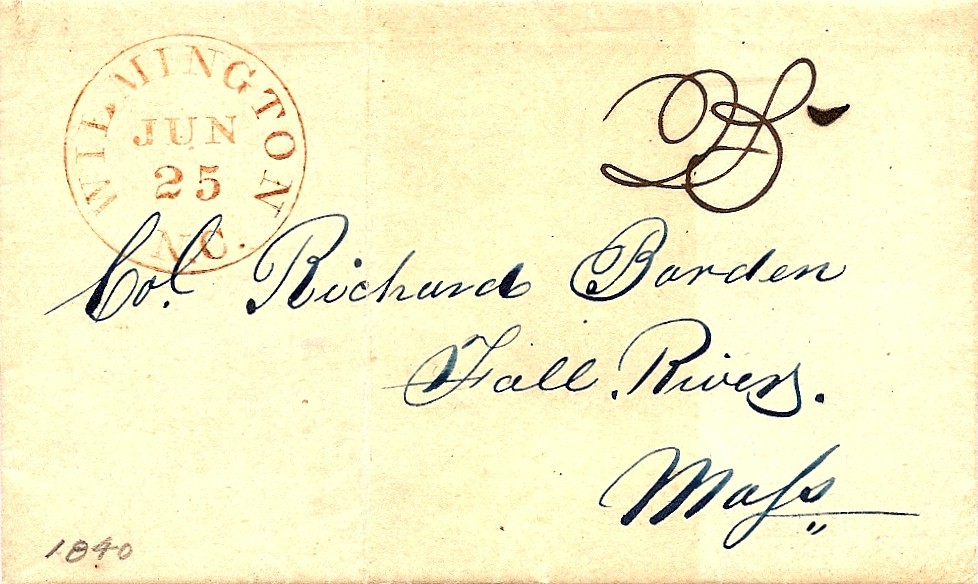
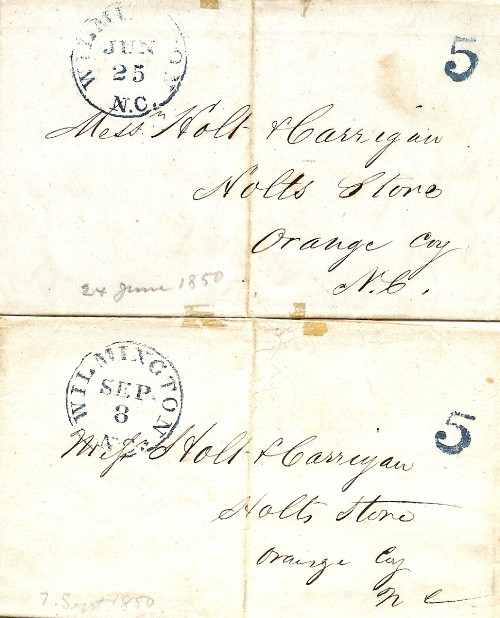
1850 Xoom View ---         Two stampless covers, the first sent on June 25, 1850 & the second sent on September 8, 1850 by DeRosset & Brown to Holt & Carrigan at Holts Store NC in Orange County. The contents of both letters refer to business transactions regarding the purchase and sale of various goods.
History:    The DeRosset family descended from French Huguenot, Armand John DeRosset. He immigrated to the American colonies in the 1730s and settled in Wilmington NC where four generations of DeRossets worked as physicians and merchants.
        Holt & Carrigan were dealers in dry goods, hardware and groceries. They were located in Orange County in the small town of Holts Store. Edwin M Holt was born in 1807. He was one of a family of six children. His father was Michael Holt III who operated a large farm, kept a machine shop, and ran a general store near the village that is now Alamance. In addition, he found time to serve in the State Legislature. Edwin's mother, Rachel Rainey Holt was the daughter of the Reverend Benjamin Rainey, pioneer minister and educator.
        Edwin grew up in a mixed environment of agriculture, mechanics, merchandising, politics and religion. From his father he inherited an insatiable curiosity and from his mother a keen intellect. He attended the log-cabin village school in winter and helped his father on the farm or in the store in summer. Whenever he could, the boy slipped away to his father's machine shop to watch the making of wheels for one of the farm wagons or the shaping of some part for the grist mill on the Creek. Mechanical things fascinated him.
        Shortly after his 21st birthday Edwin married Miss Emily Farish, the daughter of a prosperous Chatham County farmer. He built a home, "Locust Grove" on the plantation where his ancestors had fought the Battle of Alamance. The Holt's had ten children.
        A traveler through this area in January 1849 made the following description of the Holt-Carrigan factory:
        "I left the place of Pyle's Defeat toward noon, and, following a sinuous and seldom-traveled road through a forest of wild crab trees and black jacks, crossed the Alamance at the cotton factory of Holt and Carrigan . . . This factory, in the midst of a cotton-growing country, and upon a never-failing stream, cannot be otherwise than a source of great profit to the owners. The machinery is chiefly employed in the manufacture of cotton yarn. Thirteen hundred and fifty spindles were in operation. Twelve looms were employed in the manufacture of coarse cotton goods . . . "
        The factory ran successfully under the firm name of Holt and Carrigan until 1851. Mr Carrigan's wife, Nancy Holt Carrigan, who was Edwin's sister, died in that year, and shortly afterwards the former partner sold his interest to Edwin and moved with his family to Arkansas.
        Edwin then wrote to his son Thomas, who was living in Philadelphia, and asked him to come to Alamance to help manage the factory.
        "In 1853," Thomas Holt later recalled, "there came to our place of business on Alamance Creek, a Frenchman, who was a dyer, and was 'hard up' and out of money, without friends. He proposed to teach me how to color cotton yarns if I would pay him the sum of one hundred dollars and give him his board. I persuaded my father to allow me to accept the proposition and immediately went to work with such appliances as we could scrape up, an eighty gallon copper boiler which my grandfather used for purpose of boiling potatoes and turnips for his hogs; a large cast-iron wash-pot which happened to be in the store on sale at the time. With these implements I learned my A.B.C.'s in dyeing.
        "As speedily as possible we built a dye-house and acquired the necessary utensils for dyeing. The Frenchman remained with me until I thought I could manage by myself. I got along very well, with the exception of dyeing indigo blue. Afterwards an expert dyer in blue came from Philadelphia who taught me the art of dyeing in that color. He then put two negro men to work with me.
GS
In 1851 the Wilmington Chronical newpaper became the Wilmington Herald published by Talcott Burr Jr.
~~~~~~~~~~~~~~~~~~~~~~~~~~~~~~~
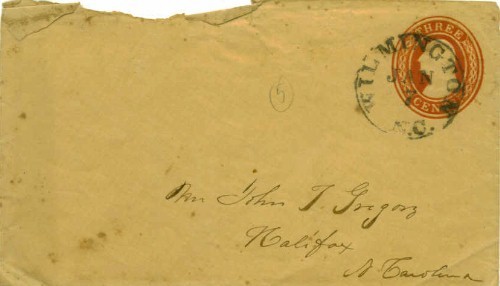
Postal rates were again reduced to 3 cents for a small envelope. Wilmington began to receive ship letters which arrived by vessels visiting the Port of Wilmington. Such mail was deposited in the old Customs House who credited part of the postage payment back to the vessel. Mail was carried by "post boys" using horse relays, stagecoaches for longer distances and later by railroads. Rivers were crossed by ferry service.
1852 Xoom View ---         A post card (circa 1963) of the Latimer House which was built in 1852 in downtown Wilmington.
History:    The Latimer House was built in the heart of Wilmington's “Historic District” for local merchant, Zebulon Latimer. His house became the residence of several generations of Latimer’s until 1963 when it became the home of the Lower Cape Fear Historical Society. The Society had been founded in 1956 and was dedicated to the preservation and study of history in the Lower Cape Fear region. The Latimer House is now open to the public as a “house museum” with 14 rooms of historic objects depicting the life of an upper class resident during the last half of the 19th Century.
OO
1854 Xoom View U-10         A cover sent on January 7, 1854 from Wilmington to Halifax NC. TB
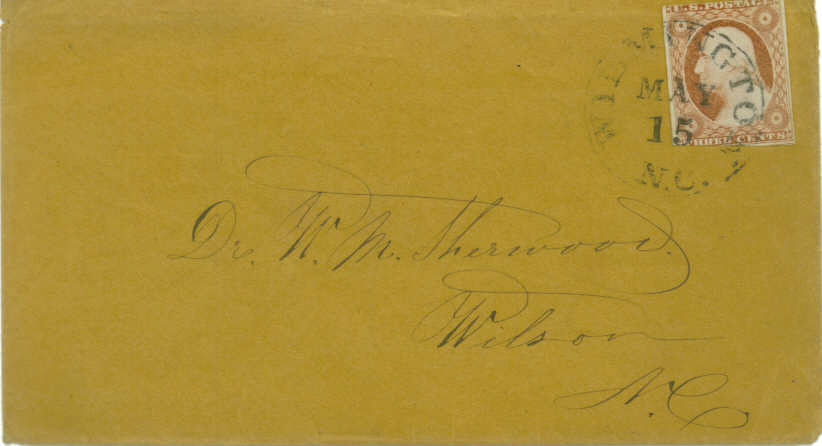
1855 Xoom View 11         A cover sent on May 15, 1855 from Wilmington to WM Sherwood in Wilson NC. RP
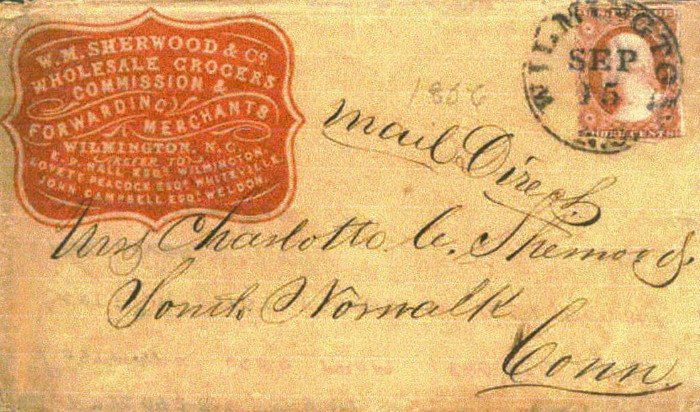
1856 Xoom View 11         A cover sent on September 15, 1856 from WM Sherwood & Co (Wholesale Grocers, Commission & Forwarding Merchants) in Wilmington to Mrs Charlotte Sherwood in South Norwalk CT. Other Commission Merchants WT
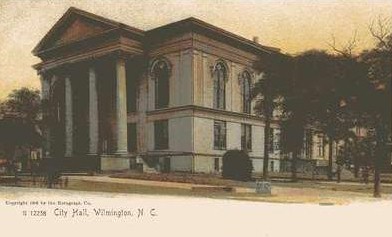
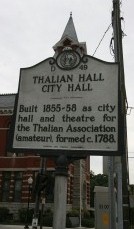
1858 Xoom View ---         A post card (picture circa 1858) of Thalian Hall/City Hall in Wilmington.
History:     The construction of Thalian Hall was completed in 1858 when Wilmington was the largest city in the state of NC. It is the only surviving theater designed by John Montague Trimble, one of America's foremost 19th-century theater architects. When it opened its doors it housed the town government, the library and an "Opera House" which seated 1,000 people (10% of the population of Wilmington). During the Civil War, Thalian Hall was in almost constant use as a place of amusement. The theater was operated by the early Thalian Association for the first two years of its operation. From 1860 through 1932 Thalian Hall was leased by private entrepreneurs, who booked road shows and star attractions.
        Between engagements the theater hosted amateur concerts, recitals, meetings, graduations, exhibitions, and even roller-skating. After the turn of the century, Thalian Hall went through several renovations. It had several close calls with demolition in the 1930's and 40's but the citizens of the community always rallied for its preservation. Following a small fire in 1973, the theater was restored to its turn of the century appearance. After reopening in 1975, Thalian Hall witnessed a dramatic increase in use by professional artists and community groups and audience attendance rose.
OO
Civil War (War Between the States) The 1860's saw the political strife of more than 40 years turn violent as the Northern states refused to allow the Southern states their own government. The struggle elevated Wilmington to national, even international prominence. The North had declared a blockade of Southern ports. This was a serious threat to Southern hopes of independence. The agricultural economy of the South would not be able to support a war effort without imports. A way had to be found to keep a stream of supplies coming in.
~~~~~~~~~~~~~~~~~~~~~~~~~~~~~~~
Wilmington came to play a crucial role in that effort. Cape Fear had two channels to the ocean. The Confederates built Fort Fisher to protect ships entering and leaving the harbor. Fort Fisher kept the Northern Union fleet far enough from the shore to allow blockade runners to slip past. Once the cargoes were discharged in Wilmington, the city's rail links could move the supplies to other parts of the Confederacy.
1860 Xoom View 8x26         A cover sent on December 1, 1860 from Wilmington to England. GS
1861 Xoom View 26         A cover sent on April 4, 1861 by HR Perrin (China-Glass-Earthenware-Cutlery), 9 Market Street, Wilmington to WM Ester in Rahway NC. GS
Eight days after the posting of the above cover, the Civil War between the north and south began with the northern bombardment of Fort Sumter on April 12, 1861.
~~~~~~~~~~~~~~~~~~~~~~~~~~~~~~~
Prior to June 1, 1861 the Union was still in control of the postal system even in the Southern States. After June 1, 1861 the Union demonetized all US stamps (declared they were no longer valid for postage) so existing stamps could not be used by the Confederates. On August 17, 1861 the Union issued a series of eight Civil War stamps (Scott #63-72). The Confederates fearing that the Union would use the postal system to spread anti-southern propaganda declared US postage stamps invalid. The Confederate States of America issued "provisional" stamp issues and several months later began to issue Confederate regular issue stamps (CSA-1/14). Initially the postal rate was 5 cents and 10 cents for an envelope travelling over 500 miles.
1861 Xoom View CSA-#68xul          A cover sent during the Civil War from Raleigh NC to Fort Johnston NC. It has a Raleigh NC Handstamp PAID 5 Provisional in blue and red. Postal markings are somewhat weakly struck as is often the case and the date is not apparent. Light coarse paper cover with “Official Business” in manuscript across the top and a military address to Capt JA Faison, 20th Reg NC Troops Fort Johnston NC.
Cover pix courtesy of John L Kimbrough, CSA Stamps & Postal History.

History:     The 20th NC Infantry was organized at Fort Johnston and received its designation as the 20th NC Infantry in November 1861. The regiment then joined the ANV in April 1862 as part of Garland’s Brigade of DH Hill’s Division and fought with the ANV (except during June through December 1864 when the regiment was part of Early’s Valley Campaign) all the way through to Appomattox Court House. Therefore this cover must date from either late NOV or DEC 1861 or very early 1862.
        There was a network of Forts protecting the Cape Fear River and water access to Wilmington. Fort Caswell was on the northern tip of Oak Island, Fort Johnston was adjacent to Smithville aka Southport and Fort Anderson was further up the river. On the other side of the Cape Fear River was Fort Holmes on Smith Island aka Bald Head Island, Fort Fisher on Federal Point (Confederate Point), Fort Meares, Fort Campbell, Fort Lee and Fort Davis.
CSA
1862 Xoom View CSA-6         A cover sent during the Civil War from Wilmington to Silver Hill in Davidson NC. The cover bears a stamp issued by the Confederate States of America (#6). TB
1863 Xoom View CSA-11D         A cover sent during the Civil War from Wilmington to Raleigh NC. The cover bears a stamp issued by the Confederate States of America (#11D). TB
1863 Xoom View UK-42         A cover sent on September 25, 1863 from Liverpool Great Britain to Nassau Bahamas via New York. It arrived in Nassau on October 14, 1863 and was placed on the Blockade Runner Ship, "Fannie" arriving in Wilmington on October 22, 1863. (Wilmington Map - 1863) WT
1864 Xoom View CSA-11         A cover sent during the Civil War from Wilmington to Pittsboro NC. The cover bears a stamp issued by the Confederate States of America (#11). OO
1864 Xoom View CSA-11         Tied by a partial strike of the Wilmington NC - June 12, (1864). Addressed to Mr WA Prevo, Jacksons Creek, Randolph County NC. The original letter is included which is an short letter from a soldier son writing home to his father. The soldier is JM Prevo who is not listed as a regular NC soldier so must have been doing guard duty in Wilmington as part of the North Carolina State Militia. He is young and barely literate, but his letter is most interesting.
Cover pix courtesy of John L Kimbrough, CSA Stamps & Postal History.

Partial letter content: “...tel Mother to Make Me som shirts for i Am gitin bare...We can hear that the Yankees have got danville Va...We have move down close to Fort Fisher..”
CSA
1864 Xoom View CSA-12         Tied by a partial strike of the Wilmington NC - July 17, (1864). Blue paper cover addressed to Mr WA Prevo, Jacksons Creek, Randolph County NC. The original letter is included which is an short letter from a soldier son writing home to his father. The soldier is JM Prevo who is not listed as a regular NC soldier so must have been doing guard duty in Wilmington as part of the North Carolina State Militia. He is young and barely literate, but his letter is most interesting.
Cover pix courtesy of John L Kimbrough, CSA Stamps & Postal History.

Partial letter content: “...We have fore hundred of the 17 year old boys for gards a Round hear...the yankees landed up the sound last nite...was drove back Bey som Artillery...tel Mother when she Mak the new Pance to put straps on them for i cant ceap these on any mor.”
CSA
Wilmington remained open until the last months of the Civil War. In January 1865, the Northern Union navy staged a massive bombardment and assault of Fort Fisher. Fort Fisher fell on January 15, 1865, followed by the surrender of Wilmington on February 22, 1865.

History:    After Fort Fisher fell, the Union turned their gun-sights on capturing Wilmington. They advanced toward Wilmington following Federal Point Road. The Confederate troops took up a strong position at Forks Road aka Cross Roads near Jumpin' Run Creek, approximately three miles south of Wilmington to make one last stand in their effort to halt the Union Army's advance. One brigade of Confederate infantry and a battery of artillery under the command of Major General Robert F Hoke entrenched themselves.
        The Federals advanced with two brigades of US Colored Troops under the command of Brigadier General Charles J Paine and expeditionary forces under the command of Brigadier General Alfred H Terry.
        The Union and Confederate forces met at the Battle of Forks Road aka the Battle of Jumpin' Run. Hoke's troops finally withdrew allowing Terry to enter Wilmington on February 22, 1865 where he accepted the surrender of Wilmington from Mayor John Dawson.

Pix from the recreation of the Battle of Forks Road February 22-24, 2008 in Wilmington, North Carolina
~~~~~~~~~~~~~~~~~~~~~~~~~~~~~~~
In downtown Wilmington there was a underground drainage network (aka Jacob's Run) that is said to have served as a refuge and pathway for runaway slaves.
~~~~~~~~~~~~~~~~~~~~~~~~~~~~~~~
After Wilmington's surrender the lifeline of Confederate supplies was broken, Grant pursued Lee catching up with him at Appomattox VA. Lee surendered on April 9, 1865 marking the end of the Civil War. President Lincoln was assassinated on the night of April 15, 1865.
~~~~~~~~~~~~~~~~~~~~~~~~~~~~~~~
After 4 years of Civil War, trade and commerce gradually returned to Wilmington and the Cape Fear region. Wilmington was supplying naval stores and exporting spirits turpentine, rosin, tar, cotton to Europe and lumber to the West Indies. The Union resumed control of the postal system.
~~~~~~~~~~~~~~~~~~~~~~~~~~~~~~~
(Wilmington Area Map - 1865)

Visit the Cape Fear Civil War Roundtable

Visit the Cape Fear Historical Institute
1865 Xoom View U-58~59         A cover sent on June 7, 1865 by Sears, Fitch & Langdon, 12 Warren St, New York City (wholesale dealers in boots and shoes) to D R Empie in Wilmington NC. Empie Historical Marker. FO
1865 Xoom View U-59         A cover sent on December 4, 1865 from Wilmington to Newark NJ. TB
Wilmington changed from a township and officially became a city in 1866. That same year the Wilmington Post newspaper was established. The Morning Star newspaper was founded a year later in 1867. The first Wilmington fire company that had been organized in 1847 was chartered in 1867 as the Wilmington Hook and Ladder Company.
1867 Xoom View 73         A cover sent to Wilmington and canceled on January 10, 1867 from the Wilmington & Manchester Railroad.
History:     The Wilmington & Manchester Railroad was one of the earliest railroads in North Carolina. It began operation in 1851/52 with rails extending from Wilmington west to Manchester SC. It was completed in 1854 and after the Civil War, its rails were extended to Augusta GA.
        Visit the Wilmington Railroad Museum.
WT
1868 Xoom View 65         A cover sent from EP George in Wilmington canceled on October 7, 1968 to DA Davis Esq in Salisbury NC.
History:    In 1810 the Connecticut General Assembly awarded a charter to the state's first publicly owned insurance firm, the Hartford Fire Insurance Company. The Aetna Fire Insurance Company opened for business nine years later. Fire insurance policies were sold to clients through insurance agents. Merchants, bankers and other professionals often acted as part-time insurance agents prior to the start of the Civil War in 1861.
        Henry Russell Savage was the Wilmington NC agent for the Hartford Fire Insurance Company from 1836 through 1861 and was the cashier of the Bank of Cape Fear from 1847 to 1861. DeRossett & Brin were the Wilmington agents for the Aetna Insurance Company from 1855 to 1861.
        In the antebellum (before the war) period insurance saw no boundaries between the south and the north. In 1861 Robert E Lee, commander of the Confederate forces during the Civil War purchased a Hartford insurance policy for his family home known as "Arlington" (now part of Arlington National Cemetery) as did Abraham Lincoln who purchased a policy to protect his home in Springfield IL.
        During the Civil War (April 1861 - January 1865) northern insurance companies suspended their operations in the south. The postbellum (after the war) period of reconstruction saw the gradual re-configuration of relations between the north and the south. EP George was the Hartford Fire Insurance Compay Wilmington agent in 1868.
        In 1868 the Hartford elk-fording-a-stream logo resembled an elk, popularized in an 1851 painting by Sir Edwin Landseer called "The Monarch of the Glen."

Letter content: Wilmington NC, October 6, 1968, DA Davis Esq, Salisbury NC, Dear Sir, A friend informs me there is a man who will give 75 cents for a few City Wilmington Bonds of the new 8% issue. He will not however pay any commission over the 75 cents. If you or your friends still feel disposed to him some bonds with funds at this figure, allowing me commission for effecting sale, I shall be glad to hear from you. Please write me at your earliest convenience. Yours very truly, EP George
RP
1869 Xoom View 65         A cover sent on December 18, 1869 by OG Parsley & Co, 8 Water St, Wilmington (Importers & Commission Merchants) to James M Sinnard in Philadelphia PA. OG Parsley operated saw mills and sold lumber, wood, coal and fertilizers. WT
1874 Xoom View UX-3         A postal card sent on February 4, 1874 by "Dintie" from Richmond VA to Theodore G Empie (in-care-of Adam Empie) in Wilmington NC. WT
1874 Xoom View UX-3         A postal card sent inside an outer cover to Montreal Canada. On the reverse of the postal card was a quotation for turpentine, rosin, tar, pitch, rosin oil, naptha, and marine paint. The card quotation is signed by Harding Johnson who dated his quotation, November 17, 1874.
History:     Johnson was a Wilmington merchant with his shop located on Nutt Street between Mulberry and Walnut Streets. He lived on Chesnut Street between Third and Forth Streets.
WT
1875 Xoom View 158         A cover sent on June 2, 1875 by Dibble, Worth & Co, 188 Pearl Street, New York City (general commission merchants) to Miss Mary Jane Worth in Wilmington NC.
History:     During the Civil War, David Gaston Worth made peanut oil in Wilmington selling it throughout the south.
        In 1870 David G Worth and CB Dibble of Granby CT formed Dibble, Worth & Co. In 1872 they were forced to suspend business because of heavy debt. They moved from Wilmington to New York City to work-off their indebtedness, subsequently prospered and returned to Wilmington in 1876.
        Charles W Worth purchased the property at 412 South Third Street in Wilmington in 1889. He demolished the existing home and built a Queen Anne-style home which was completed in 1893. On November 23, 1897 David G Worth died and the company was re-named The Worth Company with BG Worth, president and Charles W Worth, manager. Mary Jane Worth was one of the seven children of BG Worth who later married William J Woodward. The Worth family resided in their Third Street home until 1930. In 1985 it became a bed and breakfast.
RP
1876 Xoom View UX-5         A postal card sent on April 8, 1876 by Northrop & Cumming, Wilmington to Middleton Co in New York City NY.
History:     Samuel & William H Northrop and William A Cumming were proprietors for the Steam Saw & Planing Mills as well as commission merchants for corn, cotton and naval stores. Message side and Advertising Ad
WT
1879 Xoom View UX-5         A postal card sent by DeRosset & Co on May 13, 1879 from Wilmington to JL Thompson & Co in Troy NY. The postal card received a hand-carved star cancel struck in black ink.
History:     The reverse of the postal card is a quotation covering spirits-turpentine, rosin, navy pitch, tar and peanuts. For details of the DeRosset family see the 1850 cover above.
WT
1879 Xoom View UX-5         A postal card sent on June 3, 1879 from Wilmington to William Berry McKoy in Wilmington NC.
History:     McKoy was a prominent attorney in Wilmington. He was a well-known figure in the State Democrat Party and in the Masonic Order.
        He was born in Wilmington on December 24, 1852, graduated from Princeton University in 1876 and was admitted to the Bar in 1879. Although a member and chairman of the Democrat executive committee, he avoided office holding, preferring to remain an active attorney. He was involved with the development of the Masonic Order in North Carolina and the origins of Lodge #319 and other lodges in the Wilmington area.
FO
On August 31, 1886 Wilmington experienced an earthquake which lasted for about 30 seconds followed by several shorter after-quakes. The focal point of the quake was in Charleston SC.
1886 Xoom View UX-8         A postal card sent on October 13, 1886 from Washington DC to Washington Howe in Wilmington NC. FO
1888 Xoom View 213         A cover sent on June 2, 1888 from the Orton Hotel in Wilmington to Charleston SC.
History:     The Orton Hotel was located at 131 North Front Street in downtown Wilmington. It was built in 1831 and in 1949 a raging fire destroyed all but the first floor and basement. The basement currently houses a pool-room and pub, both of which are rummored to be haunted.
GS
1890 Xoom View 220         A cover sent by the Navassa Guano Co on November 7, 1890 from Wilmington to Edgefield SC.
History:    Guano is the name given to the collected droppings of seabirds, bats and seals. It is highly prized as an effective fertilizer or gunpowder ingredient due to its high levels of phosphorus and nitrogen. Superphosphate made from guano is used for aerial topdressing. Soil that is deficient in organic matter can be made much more productive by the addition of this manure. Guano consists of ammonia, along with uric, phosphoric, oxalic, and carbonic acids, as well as some earth salts and impurities.
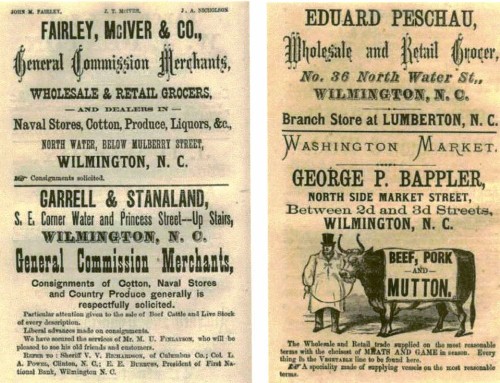
        Navassa Island is located off the west coast of Haiti in the Caribbean Sea and was owned by the Navassa Guano Co and its stock-holders. The US claimed that Navassa was an unorganized unincorporated territory but Haiti has also laid unsuccessful claim to the island. The Navassa Guano Company was initially set-up in Baltimore MD and then in Wilmington. See advertisement. The Spanish-American War of 1898 forced the guano operations of Navassa to evacuate and subsequently file for bankruptcy. Navassa Island was abandoned in 1901 and went into private ownership. It became significant again with the opening of the Panama Canal in 1914.(see 1914 below)
WT
1893 Xoom View U-349         A cover sent on September 27, 1893 from the Armour Packing Co in Wilmington to the "Bank of Fayetteville" NC.
History:    The Armour Packing Company, incorporated in New Jersey had its principal facilities in Kansas. In Kansas it slaughtered animals, dressed, cured, packed and prepared the products of their carcasses for food and other purposes. The fresh and cured meats including hams, dry salt sides, bacon, lard and beef extracts were then shipped in bulk to, amongst other places, five locations in North Carolina (Greensboro, Asheville, Charlotte, Fayetteville and Wilmington).
         In Wilmington, Armour Packing had a cold storage plant and warehouse and from these storage facilities, commission merchants and brokers sold Armour's products for both in-state and export distribution to the public.
TB
1893 Xoom View 230 & 233         A cover sent on November 8, 1893 from Wilmington to Morges Switzerland (by Lake Geneva). GS
1895 Xoom View 220         A cover sent in 1895 from the George Harriss, Son & Co of Wilmington to Ashville ME. Harriss was a ship broker and commission merchant in Wilmington. TB
On November 10, 1898 Wilmington was the location of what became known as the "Wilmington Riot." Blacks rebelled objecting to laws that provided that all male citizens could vote if they could read and write or if their grandfather voted. This denied most Blacks from the right to vote. There was an entire change in the city government that ushered in the continued prosperity of Wilmington.
1905 Xoom View U395         A Railway Post Office cover canceled on October 11, 1905 while on the Norfolk-Wilmington railroad and sent to Vineland NC.
History:     New Hanover County was served by several railroads including the Seaboard Air Line, the Atlantic Coast Line, and the Wilmington, Brunswick & Southport Railways. The Atlantic Coast Line moved its headquarters from Wilmington NC to Jacksonville FL in 1961. ACL merged with Seaboard Air Line Railways in 1967 to form the Seaboard Coast Line. The Norfolk-Wilmington branch of the Atlantic Coast Line connected with the main railroad line at Rocky Mount NC (Washington DC to Tampa FL).
         The Norfolk-Wilmington provided passenger service and also utilized special railroad cars that were staffed by Railway Mail Service postal clerks who would sort mail en route in order to speed mail delivery. The postal mail canceled on these railroad cars received special RPO (Railway Post Office) postmarks.
        Visit the Wilmington Railroad Museum.
TB
1906 Xoom View ---         A post card (circa 1906) of City Hall (1st home of the Library) in Wilmington.
History:     The construction of City Hall/Thalian Hall was completed in 1858 when Wilmington was the largest city in the state of NC. In March 1901 the North Carolina Sorosis (Federated Women’s Club - Margaret Littlejohn Kingsbury) led the community in obtaining Wilmington's first free public library. Later on December 1, 1906 Wilmington's Public Library opened its doors on the second floor of City Hall. For a short period between January 16, 1939 and December 1940, the library was closed while the north wall of City Hall was repaired from a structural collapse. It remained at City Hall until 1956 when it was moved to the Armory Building. On July 16, 1956 it was dedicated as the Wilmington Light Infantry Memorial Library remaining there until 1981.
        In 1981 the New Hanover Country Public Library moved into the Belk-Berry building at 201 Chestnut Street where the Main Library remains today. Branch library locations have since been opened in Myrtle Grove, Military Cutoff, Carolina Beach and the Law Library in the Court House.
        Visit the New Hanover County Public Library.
OO
1908 Xoom View 300         A post card sent on October 29, 1908 from SF Usher in Lilesville NC to Hall & Pearsall (Wholesale Grocer & Commission Merchant), Wilmington NC.
History:    After Jacob J Edwards died in 1876, the commission merchant business "Edwards & Hall" was dissolved and a new co-partnership "Hall and Pearsall" was formed between Benjamin Franklin Hall and Oscar Pearsall with his brother, Philander. The "Hall and Pearsall" wholesale grocer and commission merchant warehouse was located at 713-719 Nutt Street in downtown Wilmington.
        Oscar Pearsall achieved some notoriety in 1894 when he barged his Carolina Beach cottage to Wrightsville Beach where it was rebuilt. Later in 1903 he moved one of AJ DeRosset houses from the northeast corner of Third & Market Streets and built the Colonial Inn on that site. The Colonial burned down in 1962. In 1913 Oscar built the Presbyterian Church on Market Street which bears his name. Hall & Pearsall owned the schooner, "Katie Edwards" that was used for coastal trading from Wilmington up and down the coast carrying produce, turpentine and other goods.
FO
1909 Xoom View UY-4         A postal card sent on May 12, 1909 from Chicago IL to Freight Traffic Manager, Atlantic Coast Line Railroad in Wilmington NC.
History:    The Atlantic Coast Line Railroad (ACL) was the product of numerous mergers of dozens of smaller rail lines in the last three decades of the 19th century. It began as the Wilmington & Raleigh Railroad (later renamed Wilmington & Weldon Railroad) constructed between 1834 & 1840 in northeastern North Carolina. After the Civil War, the railroad's owners acquired the Wilmington & Manchester Railroad which was quickly reorganized as the Wilmington, Columbia & Augusta Railroad. In 1871 they began using the name Atlantic Coast Line as a market name for the two lines.
        Other rail lines in the Carolinas and Virginia were acquired over the next quarter century and various joint ownership and partnership agreements were established. A permanent connection to Augusta GA became a problem. It was not until 1897 when the stock of the Charleston & Western Carolina Railway was purchased, that Augusta came securely into the fold.
        In 1897-98 the various South Carolina lines were consolidated into a new company, the Atlantic Coast Line Railroad Company of South Carolina. On August 8, 1899 it acquired from the Central of Georgia Railroad as half-interest in the lease of the Georgia Railroad. This gave ACL rail connections to Atlanta and Macon GA.
        Meanwhile, consolidation of ACL component railroad companies continued in North Carolina and Virginia. Although the owners had decided to bring all of their railroads into a single company, it was determined that a state-by-state approach to consolidation was necessary given the varying regulations of each state. The Atlantic Coast Line Railroad Company of Virginia was established in early 1898 and the Atlantic Coast Line Railroad Company of North Carolina was given approval by the NC legislature the following year.
        The most favorable regulatory climate was in Virginia and the ACL's owners chose that state as the base for the combined company. The consolidation was accomplished in early 1900 when the ACL of Virginia absorbed the other companies and dropped the Virginia part of its name to become the Atlantic Coast Line Railroad Company.
         The Seaboard Air Line Railway was created in the 1880s by the consolidation of the Seaboard and Roanoke Railroad. Eventually, over 100 railroad lines would be incorporated into the Seaboard Air Line Railway. On July 1, 1900 the entire system was consolidated and became reorganized as the Seaboard Air Line Railway, a 2600-mile network stretching from Virginia to Florida. The Seaboard Air Line name had been used as a marketing name rather than the name of the company.
        The Atlantic Coast Line Railroad headquarters moved from Wilmington NC to Jacksonville FL in 1961. ACL merged with Seaboard Air Line Railways in 1967 to form the Seaboard Coast Line.
        Visit the Wilmington Railroad Museum.
RP
1910 Xoom View 374         A postal card sent by Margaret on April 14, 1910 from Wilmington to her brother, George Motter in York PA. The reverse side of this post card shows the entrance to Oakdale Cemetery.
History:     Wilmington is honored to have its Oakdale Cemetery. This sprawling historic graveyard on North 15th Street holds several sites with important Civil War connections. A monument, inscribed "To the Confederate Dead" was erected in 1870 atop the mass grave where the Confederate casualties from Fort Fisher were re-buried in 1866. The Confederate national flag, the "Stars and Bars" flies from a flagpole behind the monument. Elsewhere in Oakdale, a large expanse of untended ground amid the orderly rows of tombs is the site of mass burials of yellow fever victims during an 1862 epidemic.
        Not far away from Oakdale is the Wilmington National Cemetery located on Market Street at 21st Street. This cemetery was established in 1867 for the graves of the Union dead from the battles of Fort Fisher and Forks Road. Its stones list hundreds of identified casualties, identifying them by their home states or as "US Army Regulars" or as "US Colored Troops." Many others mark the final resting place of "US Unknown Soldiers."
WT
1910 Xoom View UX-21         A postal card sent on June 12, 1910 from Charlotte NC to William Berry McKoy in Wilmington NC.
History:     McKoy was a prominent attorney in Wilmington. He was a well-known figure in the State Democrat Party and in the Masonic Order. See post card dated 1879 above for more details.
FO
1912 Xoom View UX-22         A postal card carried on January 2, 1912 from Highwood Park Aerial Sub-Station (Highwood Park) in Wilmington and sent to C Bangs in Wilmington NC.
History:     Bad weather on January 1st prevented the flight from taking place. The next day the weather cleared and pilot, Walter Brookins flew his Wright-Breguet aeroplane carrying a mailbag with approximately 1,600 pieces of mail (canceled on Januaury 1, 1912) over a distance of three miles. The mailbag was dropped by Brookins over Winter Park and was then retrieved by a postal clerk transporting it the post office by automobile for further dispatch in the postal system. Wilmington Postmaster, Thomas E Wallace authorized the establishment of a postal sub-station at Highwood Park and this aerial transport of mail.
OO
In 1912 Wilmington had 30,000 residents living in the midst of unrivaled prosperity. With it's deep-water port and the South's finest cotton compresses, it was NC's largest banking resource.
1914 Xoom View 397         A cover sent in 1914 from the Navassa Guano Company, Wilmington NC to Ed Thomas in Peachland NC.(see 1890 above)
History:     Navassa Island which was located off the west coast of Haiti in the Caribbean Sea was owned by the Navassa Guano Company, Wilmington NC. The Spanish-American War of 1898 had forced the guano operations of Navassa to evacuate and subsequently file for bankruptcy. Navassa Island was abandoned in 1901 and went into private ownership. It became significant again with the opening of the Panama Canal in 1914.
        Shipping between the American eastern seaboard and the newly opened Panama Canal had to pass between Cuba and Haiti. Navassa Island had always been a hazard to navigation and needed a lighthouse. The US Lighthouse Service built a 162 foot tower on the island in 1917, 395 feet above sea level. A keeper and two assistants were assigned to live there until the US Lighthouse Service installed an automatic beacon in 1929. After absorbing the Lighthouse Service in 1939, the US Coast Guard serviced the light twice each year. The US Navy set up an observation post for the duration of WW-II. The island has not been inhabited since then.
        The Panama Canal had been constructed in two stages. The first stage (1881 to 1888) was carried out by a French group of companies headed by de Lessop. The second stage was done by the US who completed the canal. The Panama Canal opened for ship traffic on August 15, 1914 eleven days after war was declared between Germany and Great Britain. The US entered WW-I on April 6, 1917.
FO
World War One (the Great War 1914-1918) and by its end on November 11, 1918, nine million people had died on the battlefield. Factories and mills dotted the Cape Fear River. Shipyards gained new prominence as the war required more supply and troop ships than ever before. Wilmington prospered as a major port and ship-building center. The Atlantic Coast Line offered 26 passenger trains daily connecting Wilmington to Washington DC. Wilmington boasted one of the finest bathing and fishing resorts along the US Atlantic coast.
~~~~~~~~~~~~~~~~~~~~~~~~~~~~~~~
The US Post Office began the first regularly scheduled air mail serviced on May 15th 1918 between New York and Washington with a stop in Philadelphia.
1930 Xoom View 634         A Railway Post Office cover canceled on August 21, 1930 while on the Norfolk-Wilmington railroad and sent to Saint Louis MO.
History:     New Hanover County was served by several railroads including the Seaboard Air Line, the Atlantic Coast Line, and the Wilmington, Brunswick & Southport Railways. The Atlantic Coast Line moved its headquarters from Wilmington NC to Jacksonville FL in 1961. ACL merged with Seaboard Air Line Railways in 1967 to form the Seaboard Coast Line. The Norfolk-Wilmington branch of the Atlantic Coast Line connected with the main railroad line at Rocky Mount NC (Washington DC to Tampa FL).
         The Norfolk-Wilmington provided passenger service and also utilized special railroad cars that were staffed by Railway Mail Service postal clerks who would sort mail en route in order to speed mail delivery. The postal mail canceled on these railroad cars received special RPO (Railway Post Office) postmarks.
        Visit the Wilmington Railroad Museum.
TB
1930 Xoom View UC-1         An airmail cover sent on October 9, 1930 to Vincent Phillips in Staten Island NY. The cover commemorates the Bi-Centennial of Wilmington and is signed by Louis Moore, Secretary of the Wilmington Chamber of Commerce. The cachet mentions Wilmington's resistance to the enforcement of the British Stamp Act of November 16, 1765. RP
1931 Xoom View C-12         An airmail cover sent on July 23, 1931 by Spencer S Fountain of Wilmington to Marianna FL. The cover commemorates the visit of Captain Frank Hawks to Wilmington on his record round-trip flight between New York-Havana Cuba-New York. The cover is signed by Louis Moore, Secretary of the Wilmington Chamber of Commerce and by Captain Hawks. RP
1931 Xoom View C-12         An airmail cover sent on November 22, 1931 to AJ Fleischmann in Pelham NY. The cover commemorates the visit to Wilmington of the US Frigate Constitution (Old Ironsides) and is signed by Louis Moore, Secretary of the Wilmington Chamber of Commerce. RP
1932 Xoom View C-11         An airmail cover sent on January 1, 1932 to Columbus OH. The cover commemorates the 20th anniversary of the first air mail flight in North Carolina at Wilmington. The cover is signed by Louis Moore, Secretary of the Wilmington Chamber of Commerce. See post card dated 1912 above for more details. RP
1932 Xoom View C-12         An airmail cover sent on June 2, 1932 to Pelham NY. The cover commemorates the formal dedication of the monument erected by the North Carolina Division of the Daughters of the Confederacy. The monument commemorated the Battle of Fort Fisher near Wilmington which was the last battle of the Civil War. The cover is signed by Louis Moore, Secretary of the Wilmington Chamber of Commerce. RP
1932 Xoom View 708         A cover sent on November 11, 1932 from Wilmington to Reading MA. It commemorates Armistice Day, Ferdinand Foch and the end of WW-I.
History:     Armistice Day is the anniversary of the official end of WW-I on November 11, 1918. It commemorates the armistice signed between the Allies and Germany at Compiegne, France for the cessation of hostilities on the Western Front. It took effect at eleven o'clock in the morning — the "eleventh hour of the eleventh day of the eleventh month."
        Ferdinand Foch (October 2, 1851 – March 20, 1929), the supreme commander of the allied armies during WW-I accepted the German surrender at Compiegne.
TB
1934 Xoom View 632         A cover sent on January 15, 1934 from Wilmington to Arlington MA. It commemorates the capture of Fort Fisher, the last battle of the Civit War.
History:     Wilmington remained open until the last months of the Civil War. Finally, in January 1865, the Northern Union navy staged a massive bombardment and assault of Fort Fisher. Fort Fisher fell on January 15, 1865, followed by Wilmington a few weeks later.
TB
1934 Xoom View 737         A cover sent on May 12, 1934 to Claude Howell in Virginia. Wilmington was the home of Mrs Anna Matilda McNeill Whistler (Whistler's Mother). She was honored on a stamp that was issued on May 2, 1934 as a tribute to all mothers in America.
History:     Claude Flynn Howell was a noteworthy artist who was born in Wilmington in 1915. He spent his early summers in Rockport ME and Woodstock NY studying painting with other noted artists but always called Willington his home. Howell has been characterized as the "Dean of North Carolina Painters." He had a widespread influence on the arts in North Carolina through his painting, murals, and as an educator. He taught art at Wilmington College (now UNCW) and his classes at UNCW led to the formation of an Art Department, for which he became the director. He passed away in 1997.
RP
1934 Xoom View 713         An airmail cover sent on May 30, 1934 to Theo Light in Chicago IL. The cover commemorates the formal dedication of Bluethenthal Airport which served the needs of Wilmington. It is signed by Louis Moore, Secretary of the Wilmington Chamber of Commerce.
History:     The airfield was named in the memory of Arthur Bluethemthal who was born on November 1, 1891 in Wilmington and killed in France on June 5, 1918 while serving with the Lafayette Flying Corps during WW-I.
        Bluethenthal Airfield was carved out of dairy farmland adjacent to the Wightsboro-Winter Park Road (now Kerr Avenue). New Hanover County employed the services of Lt HW Holden, commanding officer of Pope Field in Fort Bragg NC to lay out two grass runways, one 1,700 feet and the other 1,750 feet long. Initially the airport had no lighting, no hangers, no spare parts or service crews and repair facilities.
        Coastal Plains Airways provided the first passenger service at Bluethenthal Airfield. Warren Kinchen Pennington was its manager/pilot. Coastal Plains later became Port City Flying Service, then Sea Level Airways and eventually evolved into Pennington Flying Service. In 1942 Bluethenthal Airfield was taken over by the US Army Air Corps and became the Wilmington Army Airport. The Pennington's moved their commercial air operations to Carolina Beach Airport which was located about a mile north of Snow's Cut (a bit north of Carolina Beach).
        The Army Air Corps enlarged the airport paving all runways (extended to 7,000 and 7,999 feet long) and added and improved all its facilities. After WW-II ended, the military returned the airport in 1946 to the County and it became the New Hanover County Airport. The County appointed an Airport Board to manage the airport leading to conflicts between County ownership of the land and buildings and the Borad's management responsibilities. Southeast Airlines was the first airline after WW-II to serve Wilmington followed by National Airlines.
        In 1966 the military returned to the airport when the 444th Fighter Interceptor Squadron of the Air Defense Command located F-101 aircraft and support facilities on the east side of the field. The Air Force operations continued through 1974. New Hanover County Airport was re-named the "Wilmington International Airport" in 1997.
        Visit the Wilmington International Airport (ILM).

        Visit the North Carolina Museum of Aviation.
RP
1937 Xoom View U-523
702
        A cover sent from the submarine, USS Perch visiting Wilmington NC on January 16, 1937 to George Lynch in Anchorage AK. Wilmington NC was the first port-of-call for the USS Perch before it began its service in the Pacific before the start of WW-II.
History:     The (USS Perch (SS-176) was a Porpoise-class submarine of the US Navy. Her keel was laid on February 25, 1935 by the Electric Boat Company in Groton CT. She was launched on May 9, 1936 and commissioned on November 19, 1936 with Lieutenant Commander George C "Turkey Neck" Crawford in command.
        On February 3, 1942 the Perch departed Port Darwin Australia on its 2nd patrol into the Java Sea. At this time Japan was on its campaign to conquer the Netherlands East Indies (Indonesia). The Perch took a Japanese shell to her conning tower on February 25th damaging her communication abilities. A few days later the Perch encountered two Japanese destroyers. She dived but was hit by depth charges losing her port screw. On March 2nd she surfaced and was seriously injured with leaks preventing another dive.
        On March 3, 1942 the Perch crew was ordered to abandon ship and to scuttle their sub. The entire crew was captured by the Japanese and on March 10th taken to a prison camp at Makkasser Clebes, Dutch West Indies. Six crewmembers died in captivity and the remaining 53 were handed over to the US at the end of WW-II.
TB
1937 Xoom View U-436         A cover sent on May 29, 1937 to Hanna Akerman in Niles MI. It commemorates the dedication of the new main post office in Wilmington.
History:     On July 26, 1775 the Second Continental Congress meeting in Philadelphia established an American Post Office with Ben Franklin as Postmaster General. It provided a line of posts from Falmouth in New England to Savannah, Georgia. Several years later on October 5, 1789 the first postmaster, John Bradley was assigned to Wilmington to operate the post office as a colonial office.
        Early Wilmington post offices were located in stores and hotels and the Postmasters were paid by a percentage of the mail they processed. The first post office in Wilmington was located in the old Custom House which was completed in 1846. It remained in that Federal Building until 1874 when a two-story brick building was erected on the southwest corner of Second and Chestnut Streets.
        In 1888 the construction of a main post office began on the site of the former home of RR Bridges at the corner of Front and Chestnut Streets. It was completed in 1891 and was made of brown granite from Wadesboro NC. It had two faces carved over the entrance, one happy and the other, dejected. Patrons rumored that one face had received a letter and the other received none. It was locally called the, "Brownstone Post Office."
        As Wilmington grew, it was necessary to construct a new downtown main post office. The cornerstone was laid on September 27, 1936 and the new post office was dedicated on May 29, 1937. Its lobby contains a mural painted in 1940 by William F Pfohl depicting the historic Wilmington waterfront.
RP
1937 Xoom View C-19         An airmail cover sent on October 12, 1937 from Wilmington to Wilmington. The cover commemorates the first All-North Carolina Air Mail Flights that occurred between October 11th and 16th (North Carolina Air Mail Week). During that week a special flight was made from Kitty Hawk NC. The Post Office Department authorized additional NC flights to other NC cities using Eastern Airlines (Route #6 - Wilmington). RP
1938 Xoom View 802         An cover sent on January 13, 1938 from the visiting HMS Apollo to Wilmington. The cover commemorates the visit of the HMS Apollo to Wilmington on its way to Miami FL.
History:     HMS Apollo, a light cruiser was built at Devonport, England. It was the first of a class of three cruisers all of which served in the Royal Australian Navy. The Apollo was completed in January 1936 and operated in North America and West Indies waters. On January 13, 1938 the Apollo visited Wilmington proceeding on to Miami FL on February 1, 1938.
        The Apollo was transferred to Australia in late September 1938 where she was renamed the HMAS Hobart. Following the outbreak of war with Germany (September 1939), the Hobart cruised off Australia in the East Indies and in the Indian Ocean to protect troop convoys en route to the war zone and to guard against the threat of enemy surface raiders. In April 1940 she went to the Red Sea, where she operated against Italian forces for several months. The cruiser served in the Mediterranean Sea during the last half of 1941, but was withdrawn when Japan attacked Pearl Harbor on December 7, 1941. She spent the rest of WW-II in the Pacific. Her activities in 1942 included participation in the Battle of the Coral Sea in May and the invasion of Guadalcanal and Tulagi in August.
        The Hobart also operated extensively in the Coral Sea area, covering the Allies' vital south Pacific supply lines and protecting New Guinea from enemy surface threats. While steaming west of the New Hebrides on July 20, 1943, in company with an Australian heavy cruiser and three US Navy destroyers, she was torpedoed by a Japanese submarine. Her after-hull was seriously damaged, necessitating prolonged repairs at Sydney that kept her out of service until December 1944. During the rest of WW-II the Hobart served in the Philippines and East Indies, taking part in amphibious landings at Cebu in March 1945 and Borneo in April-July. When Japan surrendered on September 2, 1945, she was part of the fleet anchored in Tokyo Bay to witness the event.
        Following the end of hostilities, the Hobart participated in the occupation of Japan for two years. She was decommissioned in December 1947 and placed in reserve. In 1953, she began conversion and modernization to prepare her for service as the Royal Australian Navy's training cruiser. This mission was canceled in 1956 and she was returned to reserve. The HMAS Hobart was sold for scrap in February 1962 and was subsequently broken up in Japan.
TB
1938 Xoom View 393         An air mail cover sent via Pan American Clipper on March 18, 1938 from Baguio, Philippines to Wilmington. Clipper mail was flown across the Pacific on Pan Am's Martin M-130 sea-plane. RP
1938 Xoom View C-23         An airmail cover sent on May 19, 1938 from Potsdam NY to Wilmington. The cover was sent during "National Airmail Week" celebrated across the US during May 15/21, 1938. A similar National Air Mail Week air mail cover sent from Wilmington to Wilmington via Raleigh NC. RP
1938 Xoom View 801x4
804
        A special delivery cover sent on November 16, 1938 from Bray Pictures Corporation in NYC to James McKoy in Wilmington NC.
History:    James Hasell McKoy was born in 1902 and became a lifelong devotee of the dramatic arts. As a young man McKoy studied at "The Inter-Theatre Arts," in New York City.
        He managed theaters throughout the eastern US and headed "Community Films" here in Wilmington. Community Films had dealings with the theatre-chain, Paramount Publix Corporation, the Roxy Theatre and Bray Pictures Corporation who made screen magazines, educational and training films. McKoy was active with "North Carolina Theatres" in Greensboro NC. He worked with the Victor Animatograph Corporation, maker of projection equipment and in 1941, he opened Saint John's Tavern in Wilmington's old Saint John's Masonic Lodge. Wilmingtpn's Thalian Hall had several close calls with demolition in the 1930's and 40's but McKoy with other citizens of the community successfully rallied for its preservation. McKoy died in 1964.
RP
1939 Xoom View 855         A cover sent on June 22, 1939 to AP Baker in Wilmington. It commemorates Wilmington's Bicentenial Celebration. The town of Wilmington was incorporated in 1739 and in 1939 became 200 years old.
        The cachet on this cover was prepared by the Cape Fear Stamp & Cover Club. On the rear of the cover is a "Wilmington Vacation Land" label.
WT
1939 Xoom View 806         A cover sent on June23, 1940 from the USS Gridley in Wilmington to Wilmington NC. It commemorates the visit of the destroyer, USS Gridley to the port of Wilmington as part of Wilmington's Bicentenial Celebration.
History:    The second USS Gridley (DD-380) was the lead ship of her class of destroyers in the US Navy. She was named for Charles Vernon Gridley.
        The Gridley's keel was laid on June 3, 1935 at the Boston Navy Yard. She was launched on December 1, 1936 and commissioned on June 24, 1937. After shakedown in the Caribbean she transited the Panama Canal and entered San Diego harbor on July 5, 1938 returning to the Caribbean in January 1939 and then to Boston for repairs.
        On her return to San Diego, on June 23, 1939 the Gridley visited the port of Wilmington NC to help celebrate Wilmington Bicentennial. She continued on via the Panama Canal to San Diego CA and in April 1940 began operations out of Hawaii. After the Japanese attack on Pearl Harbor the Gridley returned to Pearl Harbor to help protect against renewed attack and during the next five months escorted transports and repair vessels to and from Pearl Harbor and South Pacific ports.
        She teamed with destroyer Maury to escort infantry landing craft from Guadalcanal for the landings on Tambatuni, New Georgia. She sailed with the Hornet task force on June 7, 1944 to take part in the invasion of the Marianas, where US carriers pounded Saipan, Rota, and Guam. The Gridley and her sister destroyers rendered invaluable service protecting the carriers against air and submarine attack.
        The Gridley was with American forces in the pivotal Battle of the Philippine Sea (June 19-20, 1944) providing antiaircraft fire protecting US aircraft carriers. She departed Eniwetok Atoll on June 30, 1944 bound with US carriers for strikes on Iwo Jima, Guam, Yap, Ulithi and the Volcano Islands. She screened the US carriers in attacks on Okinawa and Formosa and then joined the mounting American forces for the invasion of the Philippines. While protecting the large ships off Luzon on October 28, 1944 she and destroyer Helm detected and sank Japanese submarine I-51f with a series of devastating depth charge attacks. In the succeeding days she fought off Japanese suicide planes and returned to Ulithi with damaged carriers Franklin and Belleau Wood on November 2, 1944.
        The Gridley escorted battleship Mississippi to Pearl Harbor and then sailed via San Diego and the Panama Canal for New York arriving there on March 30, 1945. She entered the New York Navy Yard for repairs. The USS Gridley was decommissioned on April 18, 1946.
        Charles Vernon Gridley was born November 24, 1844 in Logansport IN and was appointed to the Naval Academy in 1860. In the Civil War he joined the sloop-of-war Oneida with the West Gulf Blockading Squadron and distinguished himself with Farragut at the Battle of Mobile Bay on August 5, 1864. After the Civil War he was promoted to Lieutenant in 1867 and Commander in 1882 spending the next 30 years at various stations around the world including a tour as instructor at the Naval Academy.
        Captain Gridley took command of the Olympia (Admiral Dewey's famous flagship) on April 27, 1898, a post which he held despite his failing health during the Battle of Manila Bay on May 1, 1898. After the destruction of the Spanish squadron and the capture of Manila, Gridley left his command because of ill-health and died en route to the US at Kobe, Japan on May 25 1898.
TB
1939 Xoom View 806         An cover sent on July 15, 1939 to Mrs Burkhimer in Wilmington. The cover commemorates the visit to Wilmington of the USS Anderson on its shake-down cruise before entering naval service.
History:     Edwin Alexander Anderson was born on July 16, 1860 in Wilmington NC. He graduated from the US Naval Academy in 1882, was appointed Ensign on July 1, 1884 and promoted through the ranks to Rear Admiral on November 28, 1918. He had a distinguished military career retiring from active duty in 1923. He died at his home in Wilmington on September 23, 1933 and was buried in Arlington National Cemetery. The USS Anderson (DD-411) was named for him.
        USS Anderson, a Sims class destroyer was built at Kearny, NJ and commissioned in May 1939. On July 15, 1939 the destroyer made a shake-down cruise to Wilmington before serving in the Atlantic and Caribbean areas through April 1940 and thence was assigned to the Pacific. The Anderson remained in the south-Pacific, screening heavy ships, escorting convoys, bombarding the enemy ashore and carrying out patrols. She returned to the US for overhaul in March 1943 and afterwards supported the invasions of the Gilbert Islands in November 1943 and the Marshalls in early 1944. She was hit by Japanese coast-defense gunfire while bombarding Wotje on January 30, 1944 and was hit by a Japanese suicide plane on November 1, 1944 causing her to again return to the US for repair.
        Following Japan's surrender, the Anderson took part in occupation activities for a few months before steaming eastward across the Pacific to San Diego CA. In early 1946, she voyaged back to Pearl Harbor and then proceeded on to the Marshall Islands for use as a target ship in "Operation Crossroads" nuclear weapons tests. The USS Anderson was sunk on July 1, 1946 by the "Able" atomic bomb explosion at Bikini Atoll.
TB
1939 Xoom View 857         A cover sent on December 24, 1939 from Wilmington to Stronghurst IL. It commemorates the 75th Anniversary of the first attack by the north's joint Army-Navy forces to capture Fort Fisher, the last battle of the Civit War.
History:     Wilmington remained open until the last months of the Civil War. Finally, in January 1865, the Northern Union navy staged a massive bombardment and assault of Fort Fisher. Fort Fisher fell on January 15, 1865, followed by Wilmington a few weeks later.
TB
1940 Xoom View 857         A cover sent on January 15, 1940 from Wilmington to Stronghurst IL. It commemorates the capture of Fort Fisher, the last battle of the Civit War.
History:     Wilmington remained open until the last months of the Civil War. Finally, in January 1865, the Northern Union navy staged a massive bombardment and assault of Fort Fisher. Fort Fisher fell on January 15, 1865, followed by Wilmington a few weeks later.
TB
1940 Xoom View 859,860
& 861
        A cover sent on April 4, 1940 from the USS Roe in Wilmington to Wilmington NC. It commemorates the visit of the USS Roe to the port of Wilmington.
History:     The Destroyer, USS Roe (DD-418) had its keel laid on April 23, 1938 at the Charleston Navy Yard, Charleston SC. She was launched on June 21, 1939 and commissioned January 5, 1940. Under the command of Lieutenant Commander RM Scruggs the USS Roe visited Wilmington NC on April 8, 1940.
        Following shakedown, the USS Roe conducted exercises along the east coast of the US before serving in the Mediterranean and in 1944 she was transferred to the Pacific. She earned six battle stars during WW-II returning to San Francisco after VJ Day. She was decommissioned October 30, 1945.
        Francis Asbury Roe was born October 4, 1823 at Elmira NY and was graduated from Annapolis in 1848. During the Civil War in April 1862, Roe was recommended for promotion for gallantry for his actions on board Pensacola while serving as executive officer. He commanded the Sassacus as part of the North Atlantic Blockading Squadron in September 1863 capturing and destroying several blockade runners in the sounds of North Carolina. He was promoted to Rear Admiral on November 3, 1884 while serving as Governor of the Naval Asylum at Philadelphia PA. He died in Washington DC on December 28,1901 and is buried in Arlington National Cemetery.
TB
1940 Xoom View 807x2         An airmail cover sent on May 10, 1940 from Wilmington to Orangeburg NY. The cover commemorates the dedication of the opening of the Municipal Seaplane Base in Wilmington. Seaplane bases were established throughout the US to protect its cities with the escalating war situation. The cover is signed by Louis Moore, Secretary of the Wilmington Chamber of Commerce. RP
1940 Xoom View 805         A cover sent on May 10, 1940 from Wilmington to York PA. It commemorates Confederate Memorial Day. Another cachet
History:     Confederate Memorial Day was the day set aside in the South to pay tribute to those who served with the Confederate forces during the Civil War. The Confederate Memorial Day is observed on April 26 in Alabama, Florida, Georgia, and Mississippi; on May 10 in North Carolina and South Carolina; on May 30 in Virginia; and on June 3 in Kentucky, Louisiana, and Tennessee.
        When General John A. Logan (Commander in Chief of the Grand Army of the Republic - GAR) became impressed with the way the South honored their dead with a special day, he became convinced that such a day must be created to honor Union dead. He became the founder of Decoration Day (a day for the nation to decorate the graves of the war dead with flowers). Decoration Day evolved into a federal holiday, National Memorial Day which was celebrated throughout the US on May 30th. It is believed that date was chosen because flowers would be in bloom all over the country.
TB
1941 Xoom View 903         A cover canceled on April 9, 1941 commemorating the commissioning of the USS North Carolina. Another cover with a patriotic cachet.
History:     The USS North Carolina battleship (BB-55) was built in the Brooklyn Navy Yard in New York City. Her keel was laid in October 27, 1937 and she was launched into the East River on June 13, 1940. Armaments were added and she was fitted-out for her mission during late 1940 and early 1941. The USS North Carolina was commissioned on April 9, 1941.
        When Pearl Harbor was attacked by the Japanese on December 7, 1941, she was undergoing shakedown and training cruises in the Atlantic. She was directed to the Pacific in June 1942 and took part in the Solomons campaign. She covered the initial landings on Guadalcanal and participated in the Battle of the Eastern Solomons in August 1942 when she was damaged by a Japanese submarine torpedo. After being repaired at Pearl Harbor Navy Yard, she returned to the Solomons combat zone toward the end of 1942.
        In November 1943 she assisted in capturing enemy positions in the Gilbert Islands. This began a pattern of operations for her that lasted for the rest of WW-II. She served in the anti-aircraft screen of aircraft carrier task forces and used her heavy guns to bombard Japanese-held islands. During 1944 she was involved in the Marshalls operation in January-February, attacks on Central Pacific targets through the late winter and spring, the Marianas invasion and Battle of Philippine Sea in June, and Western Pacific carrier strikes in November and December.
        The USS North Carolina continued her Western Pacific activities in 1945 participating in the invasions of Iwo Jima in February and Okinawa in March and April. She also screened carriers on raids throughout the combat zone including attacks on the Japanese home islands. She was off-Japan in August and September during Japan's surrender.
        The USS North Carolina returned to the US in October 1945 and operated in the Atlantic until she was inactivated in 1946. She was decommissioned in June 1947 and became part of the "mothball" fleet until stricken from the Navy list in June 1960. On October 2, 1961 she arrived at her current berth in Wilmington NC. Later the next year, on April 29, 1962 the USS North Carolina was officially dedicated as North Carolina's museum and memorial to its WW-II veterans.
        Visit the USS North Carolina Battleship Memorial.
RP
1941 Xoom View 899x2         A cover sent on December 6, 1941 (the day before Pearl Harbor) from Wilmington to Wilmington. The cover commemorates the launching of the "Zebulon B Vance" Liberty Ship, the first ship built at the new Wilmington shipyard.
History:    Zebulon Baird Vance was known as North Carolina's Civil War Governor. He was born in Buncombe County NC on May 13, 1830 and attended the University at Chapel Hill who granted him a County Court license in Raleigh in late 1851. In1858 Vance won his first congressional seat and was re-elected in 1860. At 28 he was the youngest member of Congress and one of the strongest Southern supporters of the Union. In March 1861 when indications were that the North Carolina legislature was going to vote for secession, Vance resigned his seat and returned to NC.
        When the ordinance of secession was passed in May 1961, Vance was a captain in Raleigh commanding the company known as the "Rough and Ready Guards." Vance and his men soon became part of the Fourteenth Regiment. Vance was elected colonel of the Twenty-sixth North Carolina Regiment leading his men in the field for thirteen months and distinguishing themselves at New Bern in March 1862 and at Richmond in July 1862.
        Vance became the "soldier's candidate" for North Carolina governor taking office in September 1862 and was re-elected in 1864. Governor Vance was a Southerner but was a North Carolinian first. With the fall of Fort Fisher in January 1865 followed by Wilmington a few weeks later, the last port open to the Confederacy was closed. Governor Vance was arrested and taken into custody by North's Union troops. He spent time as a prisoner in the Old Capital Prison in the District of Columbia.
        At the civil war's end in 1865, Vance was paroled and returned to NC. In 1870 Governor Vance won one of the North Carolina seats in the US Senate but still under parole, was not allowed to serve. Then in 1878 Governor Vance was re-elected to the US Senate where he held office until his death on April 14, 1894.
        In 1941 with the world in conflict with the impending WW-II, Wilmington received government contracts for the crash construction project to create a huge shipyard initially to mass-produce "Liberty Ships." These ships were needed to allow the US to supply its armies and its allies with necessary equipments, supplies and materials.
RP
World War Two - On December 8, 1941, the day after Japan bombed Pearl Harbor, the US declared war on Japan. Three days later on December 11th Germany and Italy declared war on the US, forcing President Roosevelt to e